
Bambu Lab H3C unveiled: 3D printer with tool changer featuring nine print tools
This article was translated automatically from Turkish by AI; in case of doubt, the Turkish original prevails. Read the Turkish original
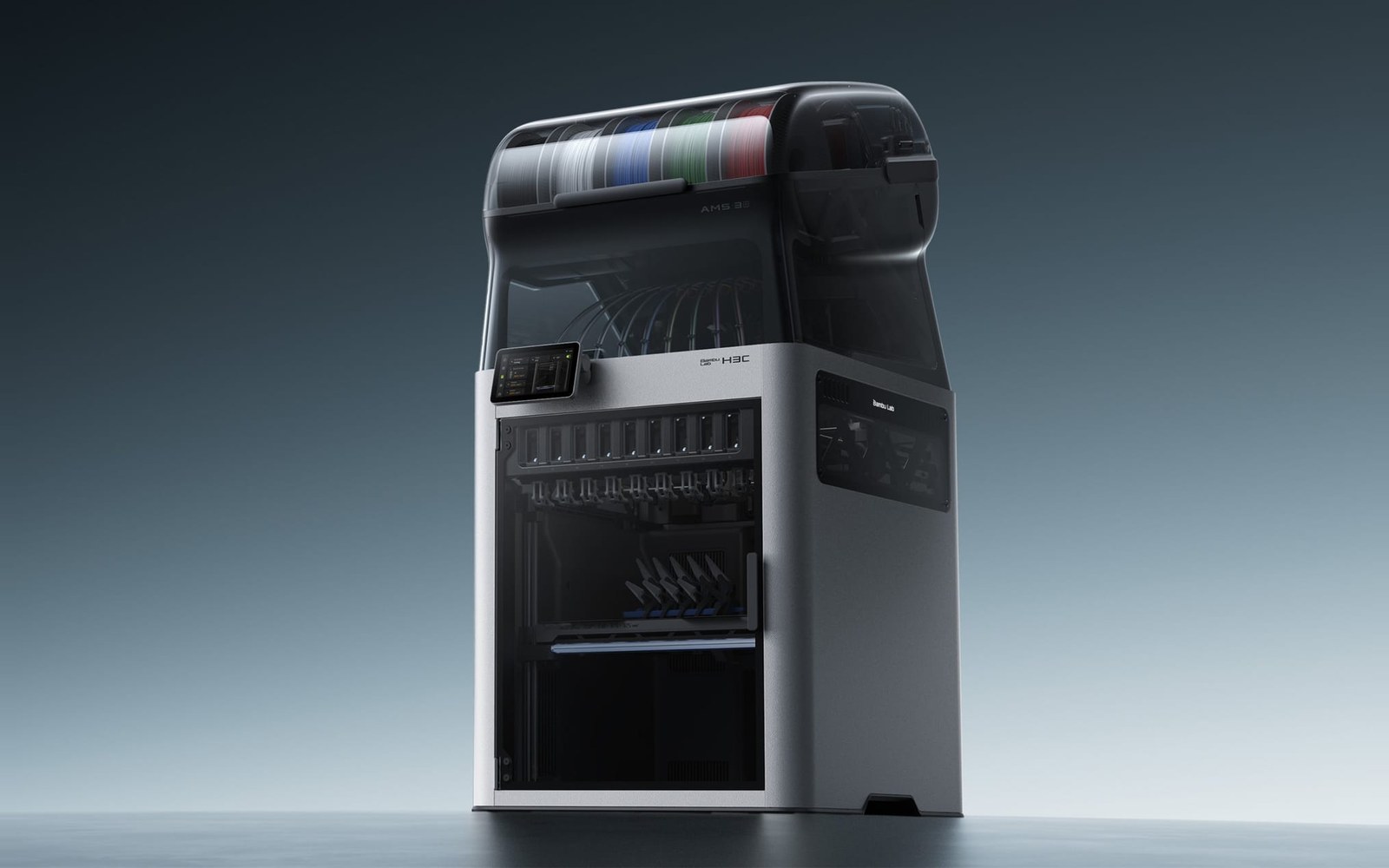
On November 3, 2026, Bambu Lab announced its third-generation first printer, the H3C. Swaptek tool changer architecture offers nine print tools, with material changes under 6 seconds according to the manufacturer. Integrated AMS 3H supports two filament diameters, with FlexFeed extruder and specifications.
What was announced?
On November 3, 2026, Bambu Lab introduced the H3C as the company's first third-generation printer. The FFF-type printer focuses on multi-material printing. The machine is built around three main parts: Swaptek for tool changes, FlexFeed extruder for flexible materials, and AMS 3H for storing, drying, and feeding filament.
Swaptek: nine print tools
The Swaptek architecture includes nine print tools, each with its own filament path and heater. Filament stays loaded in the tool and can be preheated before changing; there's no need to retract one material and feed another. The manufacturer claims that with the Active Pre-Heat feature, material changes from print to print are reduced to under 6 seconds with minimal priming required.
According to Bambu Lab, this allows for free color mixing, using different nozzle diameters in the same print, and operating auxiliary tools like CutTool, DrawTool, and DebossTool, making them suitable for everyday use.
FlexFeed and AMS 3H
The FlexFeed extruder handles both 1.75 mm and 2.85 mm filaments. The manufacturer states that with 2.85 mm TPU, soft TPU with a hardness of up to 75A can be reliably printed at up to 3 times the flow rate of a conventional printer.
AMS 3H is an integrated, fully enclosed filament management system. Each spool is stored in an airtight compartment that protects it from moisture and reads RFID tags to sync with the printer and slicer. There are nine slots, separate entries for TPU, and two drying slots that can operate up to 85 °C during printing. A previous generation AMS can connect to the first print tool, allowing up to 24 materials in a single print.
Motion system and technical specifications
According to the manufacturer, the print head and X-axis assembly are 40% lighter; the H3C reaches up to 25,000 mm/s² acceleration and 1,400 mm/s speed, with prints completing more than 10% faster on average than the previous flagship. These values are from Bambu Lab's own statements.
Technical specifications announced include: 330 × 320 × 325 mm build volume, 350 °C nozzle, 120 °C bed, active chamber heating up to 65 °C, hardened steel nozzles (0.2/0.4/0.6/0.8 mm), H11 class HEPA filter, 493 × 571 × 587 mm external dimensions and 36.28 kg weight including AMS 3H. Features include automatic pre-print calibration, dual-camera monitoring with optional BirdsEye camera, and optional Vision Encoder aiming to keep precision under 50 µm.
Announcement and current printers
The announcement is a product introduction; no information on sales and delivery schedule in Turkey is included. On the same day, Bambu Lab also announced it is working on hybrid print support for combining different nozzle diameters in a single piece for H2D, H2C, and X2D, expecting some features this year and others by the first quarter of 2027.
Sources
- Bambu Lab – Tool changer. Game changer. Bambu Lab presents H3CSource date: 3 November 2026
Rate this article
Your rating is stored in your account; everyone else sees only the average and the number of ratings. Details on the Privacy page.