
Kerf Compensation in Laser Cutting: Width, Factors, and Interlocking Joints
This article was translated automatically from Turkish by AI; in case of doubt, the Turkish original prevails. Read the Turkish original
Kerf is the width of the cut removed by the laser beam from the material. According to xTool, this value generally ranges from 0.08-1 mm; examples are approximately 0.15-0.38 mm for metals, and 0.25-0.51 mm for wood and plastics. Dot size, thickness, focus, power, and speed affect the kerf. In small gaps and interlocks, path shifting or software adjustments are needed for compensation.
What is Kerf, and Why Does it Leave a Gap
When a laser cuts a material, it vaporizes or burns a thin strip touched by the beam. The remaining gap is called the kerf, and its width is known as kerf width. Ideally, this width is close to the beam's dot size, but in reality, material, thickness, and cutting settings change the value.
According to xTool, laser cutting kerf generally ranges between 0.08 mm and 1 mm. This means extra material is removed from the edge of your path. If a gap or detail in your design is thinner than the kerf width, it could disappear in the cut. Thus, dimensions are planned considering the kerf before assembling the parts.
Factors Changing Kerf Width
Dot size is the first factor: the material burns according to the diameter touched by the beam; the kerf is often equal to or slightly wider than this diameter. Since the beam is slightly conical, the kerf on the bottom surface of thick material may be more open than on the top. If the focus is on the surface, the cut is usually narrower; when the focus is moved into the material, the surface dot enlarges and the kerf widens.
Material type also matters. xTool lists typical kerf for metals as approximately 0.15-0.38 mm, and for wood and plastics as approximately 0.25-0.51 mm. These ranges do not replace the actual value on your machine; even the same thickness can produce different results with different sheets.
As power increases, more material is removed and the kerf may widen. When the cutting speed rises, the beam stays less time on the same spot; the kerf may narrow. Straight cuts give more stable width. If the head slows when changing direction and speed in curves, the kerf may widen at corners or arcs. These factors do not operate independently; the final width results from their combined effect.
When to Consider Kerf
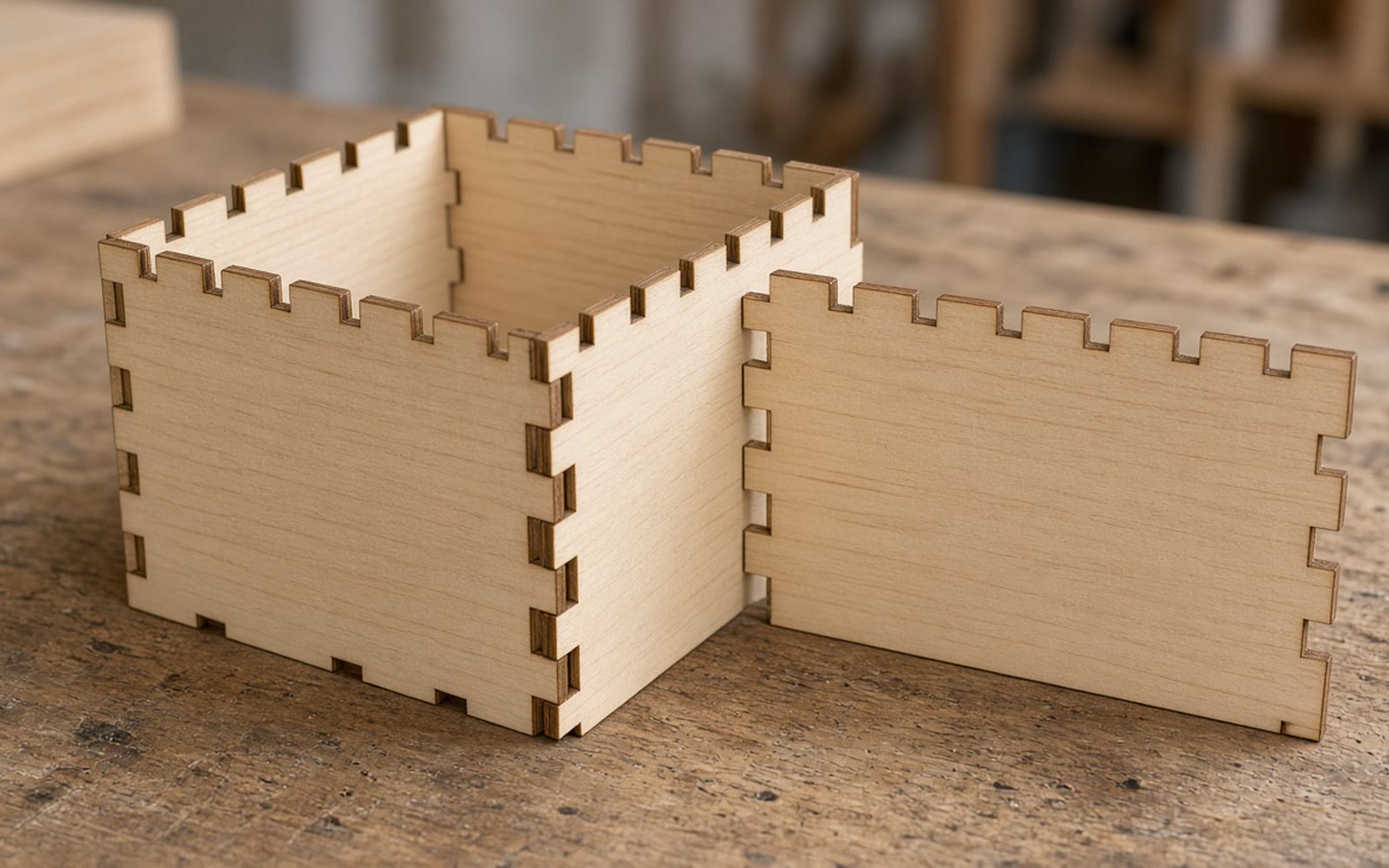
A small kerf often doesn't spoil the result in simple and large parts. In thin slots, small gaps, and jewelry-scale patterns, kerf width significantly affects the outcome; details thinner than the kerf can vanish in the cut. Dimensions in interlocking joints should also be planned considering the kerf. xTool's practical advice is: ensure your cuts and material thickness are at least as wide as the kerf.
Compensation, Measurement, and Safety
One way of compensation is to shift the cut path by the kerf amount outside the part (or inside for holes). You can also make this adjustment by adding or subtracting dimensions in the design. Many cutting software allow you to enter a kerf value based on the material, power, and thickness; the machine adjusts the path accordingly. xTool mentions cutting software as examples of such adjustments. It's important to test the value on your own material and not over-tighten fits.
Rather than trusting a ready-made chart, cut a test from the same sheet, check the fit, and note the setting used. Different thicknesses or a different material demand a new test.
Keep the lid closed and ventilate the area during cutting. Do not cut PVC and vinyl; these materials release harmful gases. The ranges in this article are xTool's general descriptions, not your machine's measurements. No processing on the power supply or network cable is described.
Sources
- What Is Laser Cutting Kerf? Essential Insights for Precision CuttingSource date: 2 December 2023
Rate this article
Your rating is stored in your account; everyone else sees only the average and the number of ratings. Details on the Privacy page.