
How to Make 3D Printed Parts More Durable: A Guide to Walls, Layers, Temperature, and Design
This article was translated automatically from Turkish by AI; in case of doubt, the Turkish original prevails. Read the Turkish original
If functional 3D printed parts are breaking, the solution is often not 100% infill. Learn how adjusting wall count, layer height, print temperature, infill pattern, material choice, and part design can stepwise enhance durability. Values are starting points.
Focus on the Right Settings First
When a functional part breaks in use, the first thought is often to increase infill to 100% or print very slowly. Creality's guide from October 28, 2026, lists six methods from most to least impactful: wall thickness, layer height, temperature, infill, material, and part design. You don't need to apply them all at once; start with the initial steps and add others as needed. The values below are starting points from the source, not guarantees.
1. Increase Wall Count
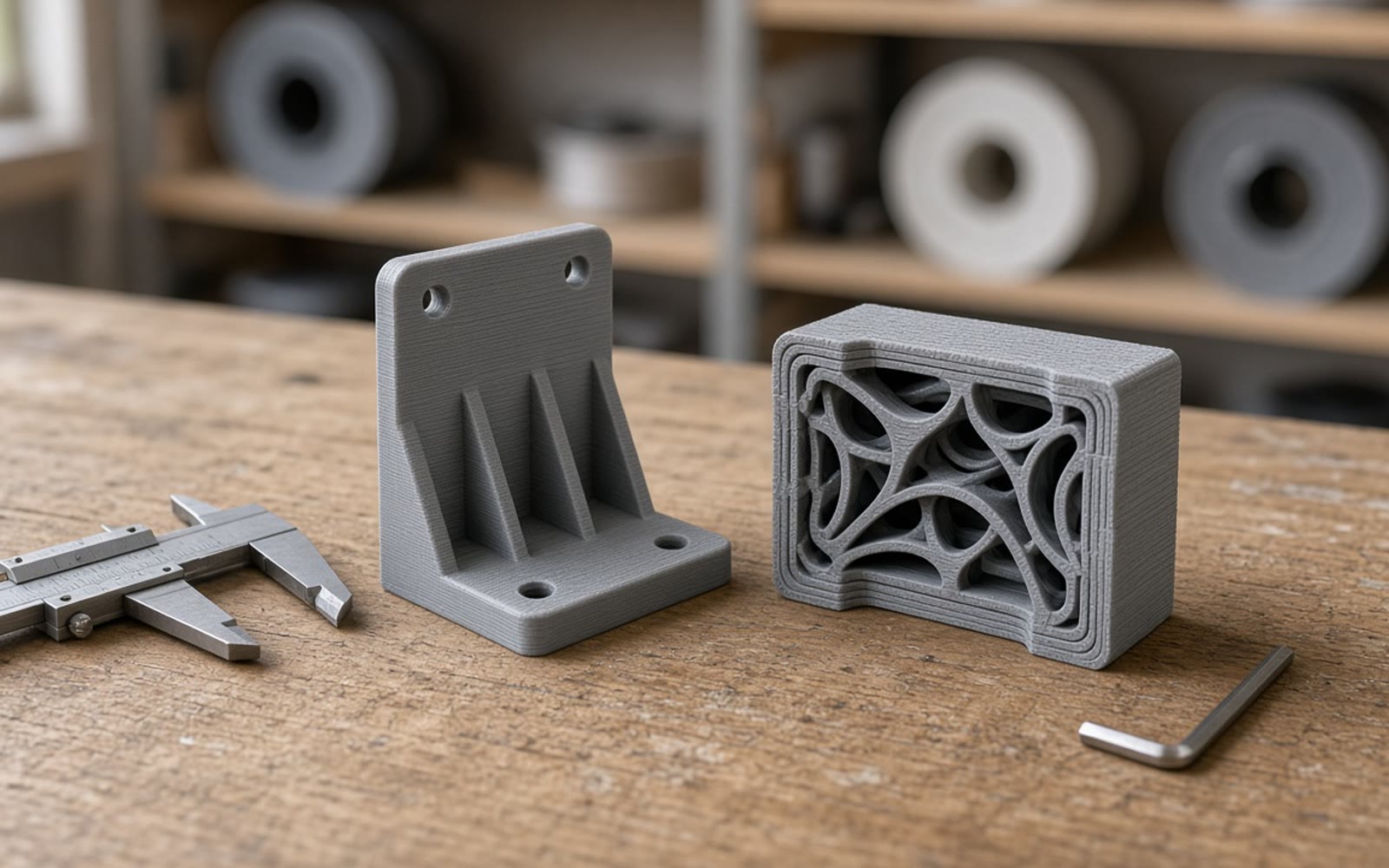
According to the source, walls contribute more to strength than infill; walls bear the external load significantly, while infill supports the internal structure and top surfaces. For normal functional parts, 3-4 walls (approximately 1.2-1.6 mm with a 0.4 mm nozzle) are suggested, and for parts under high loads, 5-6 walls (2-2.4 mm) are a starting range. Use at least 4 walls around screw holes and joints; consider local reinforcements with extra perimeters, ribs, or modifiers in the slicer.
2. Balance Layer Height
For a 0.4 mm nozzle, a 0.2 mm layer height is a good starting point; the source considers approximately 0.16-0.24 mm practical for functional parts. A practical rule is about half the nozzle diameter. Too thick layers reduce overlap between lines; too thin layers disproportionately increase print time.
3. Adjust Temperature and Fan
Printing close to the upper end of the filament manufacturer's recommended range can improve layer adhesion; increase the temperature gradually, as excessive heat can cause stringing and dimension distortion. Starting values from the source (nozzle/bed): PLA 220-230 / 50-60 °C, PETG 245-250 / 70-80 °C, ABS 240-250 / 90-110 °C, ASA 240-255 / 90-110 °C. Fan start: PLA 50-75%, PETG 20-30%, ABS/ASA 0-30%. Always consult the filament manufacturer's data and run a temperature test before critical parts. Print ABS and ASA in a well-ventilated area with an enclosed case only.
4. Choose Infill Pattern Wisely
Triangle, grid, and gyroid patterns are good options for strength; gyroid is a go-to choice for parts that take loads from different directions. For infill, the source suggests 20% for decorative parts and 30-50% for functional parts as a starting point. 100% infill significantly increases material, time, and internal stress, but benefits grow less; instead, increasing wall count or reinforcing only loaded areas is often more efficient.
5. Choose Material for Intended Use
PLA is hard but brittle and starts softening around 55 °C according to the source. PETG bends rather than breaks and withstands up to about 70 °C. ABS and ASA are more heat-resistant and require an enclosed case; ASA's UV resistance makes it suitable for outdoor parts. Nylon absorbs moisture and should be stored in a dry box. Carbon fiber-filled filaments are abrasive; use a wear-resistant nozzle recommended for the material.
6. Design the Part for Strength
FDM prints are weaker between layers than along continuous extrusion lines. Orient the part so the load moves along layers. Add ribs, 2-5 mm radii in inner corners, gussets, and thick bosses around screw holes. Wall thickness should be at least 1.2 mm for decorative parts and 2-3 mm for functional parts; overhangs steeper than 45 degrees create weak points.
Brief Summary
First focus on orientation, wall count, and layer adhesion; then on material and design details. Test each change individually and observe how your part behaves in real use.
Sources
- Creality – How to Make 3D Prints Stronger?Source date: 28 October 2026
Rate this article
Your rating is stored in your account; everyone else sees only the average and the number of ratings. Details on the Privacy page.