
Flexible Filament Guide: TPE, TPU, Shore Hardness, and Printing Tips
This article was translated automatically from Turkish by AI; in case of doubt, the Turkish original prevails. Read the Turkish original
TPU and TPE labels often get confused; the real choice is based on Shore A hardness. This guide concisely summarizes the Shore bands, direct-drive preference, drying, and slicer tips from Snapmaker's August 3, 2026 article.
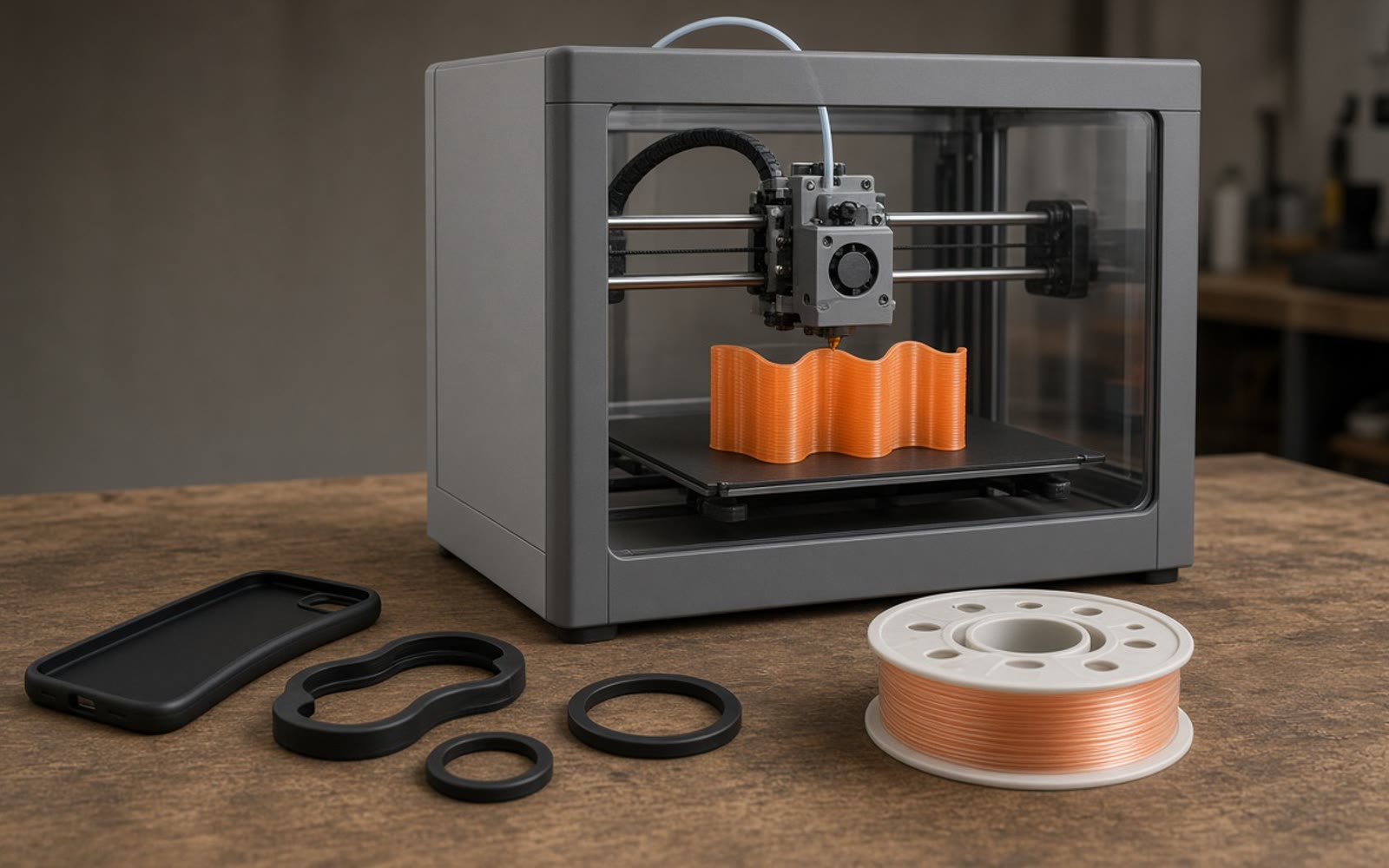
Difference Between TPE and TPU
TPE (thermoplastic elastomer) refers to the general family of flexible plastics similar to rubber. TPU (thermoplastic polyurethane) is a widely used member of this family. A spool labeled only as “TPE” is often an older and very soft blend; it's necessary to check the Shore value on the label before purchasing.
Flexible filaments are almost always on the Shore A scale. A lower number means softer. Shore 00 is too soft for printing; Shore D is close to hard plastics. The practical bands in the source are summarized as follows: about 90A is very soft (shoe foam feel, high elongation, slower and more difficult to print); around 95A is harder and the best starting point for beginners; for jobs like phone cases and RC tires, the source recommends 95A HF (high-flow) and notes that this version can be printed faster.
Material Selection
The source frames its selection advice as: 90A for wearable parts, shoe soles, and dampers; 95A HF for cases, tires, and assembly parts; TPC (thermoplastic copolyester) for high heat or more challenging environments; Soft/Flexible PLA for decorative bendable parts and hinges (it bends but doesn't stretch). These are starting orientations; the filament manufacturer's technical sheet always takes precedence.
Soft PLA does not replace TPU; it is mentioned as an initial step for tasks where bending is sufficient, such as cosplay armor, flexible straps, and hinges. TPC is noted for its emphasis on industrial-level heat and chemical resistance.
Hardware and Moisture
In systems with long Bowden tubes, soft TPU can be compressed within the tube (the “wet noodle” effect). The source prefers short-path direct-drive extruders. Removing supports from soft TPU is difficult; if the machine permits, using hard PLA/PETG supports that don’t stick to TPU can facilitate clean separation in multi-material printing.
TPU is highly hygroscopic. The source provides, for example, drying in an active dryer at 70°C for 6–12 hours before printing; it recommends keeping the filament dry during long jobs. Wet filament may cause popping noises, stringing, and porous weak parts. 70°C / 6–12 hours is a starting value, not guaranteed; check with your filament and dryer manufacturer's chart.
Slicer Tips
Practical suggestions from the source: manual loading instead of automatic; short and slow retract in direct-drive (about 1.0–1.5 mm, 10–20 mm/s); turn off dynamic flow calibration on soft materials (flexibility can mislead sensors). About 15–20% gyroid infill with 90A for soft wearable parts is mentioned as an example for a cushioning feel. Speed ranges (e.g., about 30–50 mm/s for soft 90A, higher for HF) are provided as examples; test on your own printer.
The aim is to read the Shore label, establish direct-drive and dry filament habits, and verify settings with a small test piece.
Sources
- Snapmaker Blog – Flexible 3D Printer Filament Types: Guide to TPE, TPU, and BeyondSource date: 3 August 2026
Rate this article
Your rating is stored in your account; everyone else sees only the average and the number of ratings. Details on the Privacy page.